









































 |
 |
 |
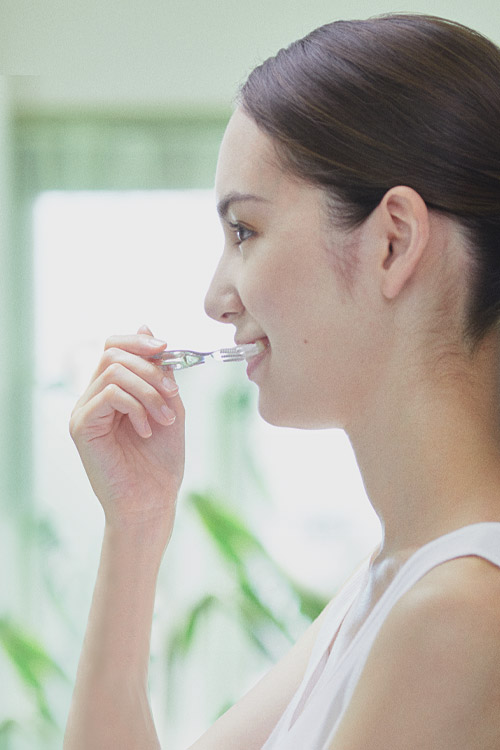
Both at school and at home, children are trained to brush their teeth thoroughly and habitually. As adults, however, many people become indifferent to brushing their teeth. Of course, dental caries is not a disease that affects only children. In fact, adults may be even more susceptible to decay. Take, for example, the gums. With age, the muscles become slack and food particles may remain wedged between the gums and teeth. Food may also get lodged in spaces formed between teeth. Thus, dental caries in adults develop at other sites than in childhood. Yet another reason that many adults are at risk is because they brush their teeth according to their own style developed over any number of years and as a result fail to notice that they aren’t reaching certain spots when they brush. So please consider your own method. Are you sufficiently brushing all the hard-to-reach areas in your mouth? Your oral environment will change considerably if you only reconsider your brushing habits.
 |
The presence of tooth decay in the early stages has been diagnosed visually using a “dental explorer.” Recently, newer methods of detecting dental caries in the very early stages have been developed, such as the quantitative light-induced fluorescence (QLF) method, which utilizes the fluorescence in the enamel (see Photo). Detecting dental caries in the early stages helps to keep treatment to a minimum (Minimal Intervention, MI)and makes it easier to maintain natural, healthy teeth. |
|
|
 |
 |
| Fluoride plays an important role in preventing dental caries in adults and children alike. How do we best keep fluoride in the mouth? In the USA, fluoridation of the public water supply has been performed for more than 50 years, but in Japan, where no such step has been taken, tooth brushing is the most effective method to supply fluoride. Nowadays, a number of toothpastes contain fluoride and help maintain the fluoride concentration in the mouth at a stable level thus preventing dental caries. The key to keeping fluoride in the mouth as long as possible is the after brushing care. Swish toothpaste around in your mouth for a while before rinsing out your mouth with water. |
 |
 |
| Needless to say, saliva is important for the maintenance of oral health. For example, without saliva, you would not be able to swallow even after prolonged chewing. Without the moisture supplied by saliva, speaking would be difficult. And for teeth, its action to kill bacteria makes saliva so important as it washes the oral cavity free from particles. But people of today under stress are reported to have reduced secretion of saliva. Here, too, tooth brushing helps. It stimulates the mouth and helps increase saliva secretion. Tooth brushing three times a day refreshes not only your soul, but also your mouth. |
 |
| “You may consider the toothbrush as a tool for placing toothpaste into your mouth” (by Prof. Kambara) |
|
 |
|